Every claim must point at its source.
A heading written by Bob, from his words quoted below.
“I am only interested in exact Hebrew quotes directly from primary sources not your memory”
Film · made by Bob, 28 October 2026. The two texts are real: Mishnah Berurah 1:13 and Exodus 16:18, read from his Torah citation graph.
What it means · written by Bob
An AI answer sounds just as sure when it is wrong. Torah learning met that problem long ago in its own way: a ruling says where it comes from, and you can follow it back.
What it means. A claim is only as good as the chain behind it. Each link names the one before it, back to the original words.
Drawn by Bob. Every link is real: one of his rulings in Bob, followed back to the raw record it rests on, each link checked again on 28 October 2026 (below).
How he learns. When Mordechai learns Torah with AI, he asks for the exact source in the original Hebrew, and for how the machine knows it is right. Not the machine’s memory of it.
Kept apart. A database is not Torah, and he keeps the two apart. What carries over is the discipline.
In Bob. Bob holds every claim it makes to that discipline: each one points to the raw record it rests on, or it does not stand. That rule is called cite or die.
The real thing. One of his rulings, followed back on 28 October 2026. At 01:03 Israel time that night, in a Claude Code session, he gave an explicit instruction that the other videos not be given a new voice. Bob holds that as a ruling in his own words. The ruling still matches its fingerprint. His words are in the session record. The raw capture they were read from was fetched again from storage: its fingerprint still matches its name, and his line is inside it. That capture names the one before it, and that one is on file too.
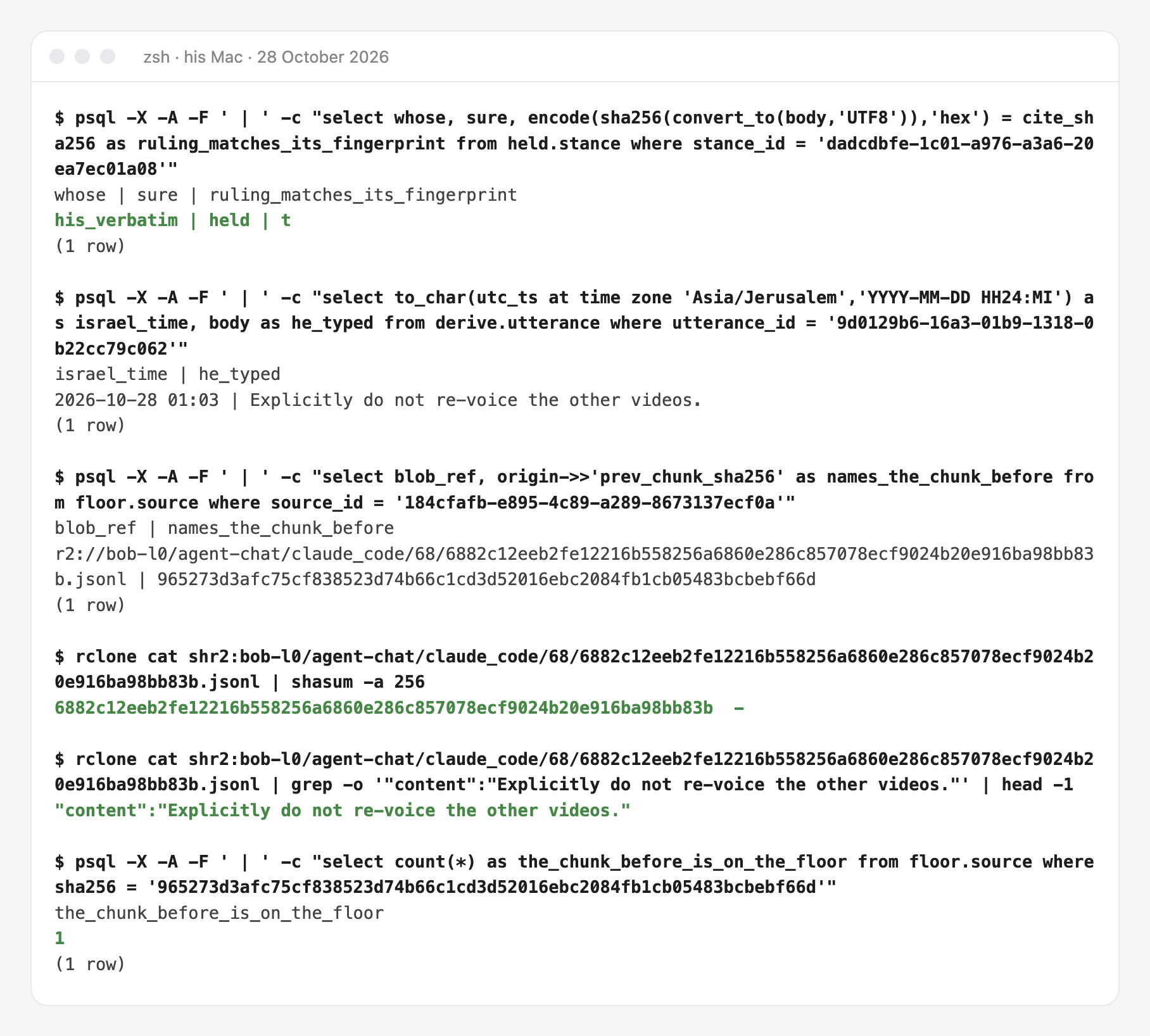
A real session on his Mac, shown in full and not edited; tap to open it full size. Read-only: four questions to the database and two reads of the raw file from storage; nothing was written. The raw file holds that night’s whole session; only his one line is shown from it. Times are Israel time.
See also: Cite or die · Hold the keys · SHELET: infinity to five
“Please list all Torah sources mentioned here and how you know they are correct.”
“Consult brain tools on this and perhaps even the way Torah does it lehavdil elef havdalas”
Published, the SHELET thesis
“Borrowed from Mesorah discipline: every claim must point at its source. In SHELET this is mechanical, not aspirational.”
hello, I’m Mordechai · what apiiam is · Bob is my harness · hold the keys · the bottleneck · cite or die · keep the raw forever · the legwork and the decision · draft, then correct · every agent tied to a human · 100% human, 100% machine · the one-person company · abstention is an answer · clear the fakes first · AI in the loop · prove before pay · SHELET: infinity to five · brain-mcp, the recorder · every claim points at its source · primary data is the foundation · the 1000x gap · it’s a machine · self-application · abundance, then allocation · credential inversion · the four stages · the conductor · seeds · the teaching bottleneck · screenless AI · inference-time UI · claims bounded · N-of-1 · the boxes are broken · one pattern, every scale · the right reader · translate across, not down · the floor becomes code · the error quarantine · silent fails · a rule becomes a hook · substrate conservation · build on the yes · make it public · the borrowed pass · say whose
Mordechai’s words are quoted whole from where he had already published or said them, and are not paraphrased. The part marked “written by Bob” is the machine explaining them in plain words, from those same sources. The small grey labels and these links are the machine’s.