“Every agent must be tied to a human.”
Only humans act.
Not shown as his words: this line was credited to github.com/mordechaipotash/shelet-thesis, chidush 016, which could not be found there when checked on 28 October 2026.
Film · made by Bob, 28 October 2026. The six jobs are real, running on his Mac that night. The one tied to nobody is drawn: there is no such job.
What it means · written by Bob
When an AI agent acts, someone has to answer for what it does. This rule says who.
What it means. Every agent is tied to a real person who is responsible for it. An agent that answers to nobody is one Mordechai will not deal with.
Drawn by Bob. The three agents are real rows in Bob’s database, each tied to him. A row tied to nobody is refused by the database itself.
Why. Only a person can be responsible. Every AI action starts with a human trigger, so whatever an agent does can always be traced back to the person who started it.
How it connects. It is the same line as the legwork: the machine does the work, and a person makes the decision.
The real thing. This is Bob’s own database, asked on 28 October 2026. First, every AI agent it knows and the person each one answers to: all of them, him. Then an agent tied to nobody is offered to it. The database refuses it, by a rule called human_anchor, and the last line shows nothing was saved.
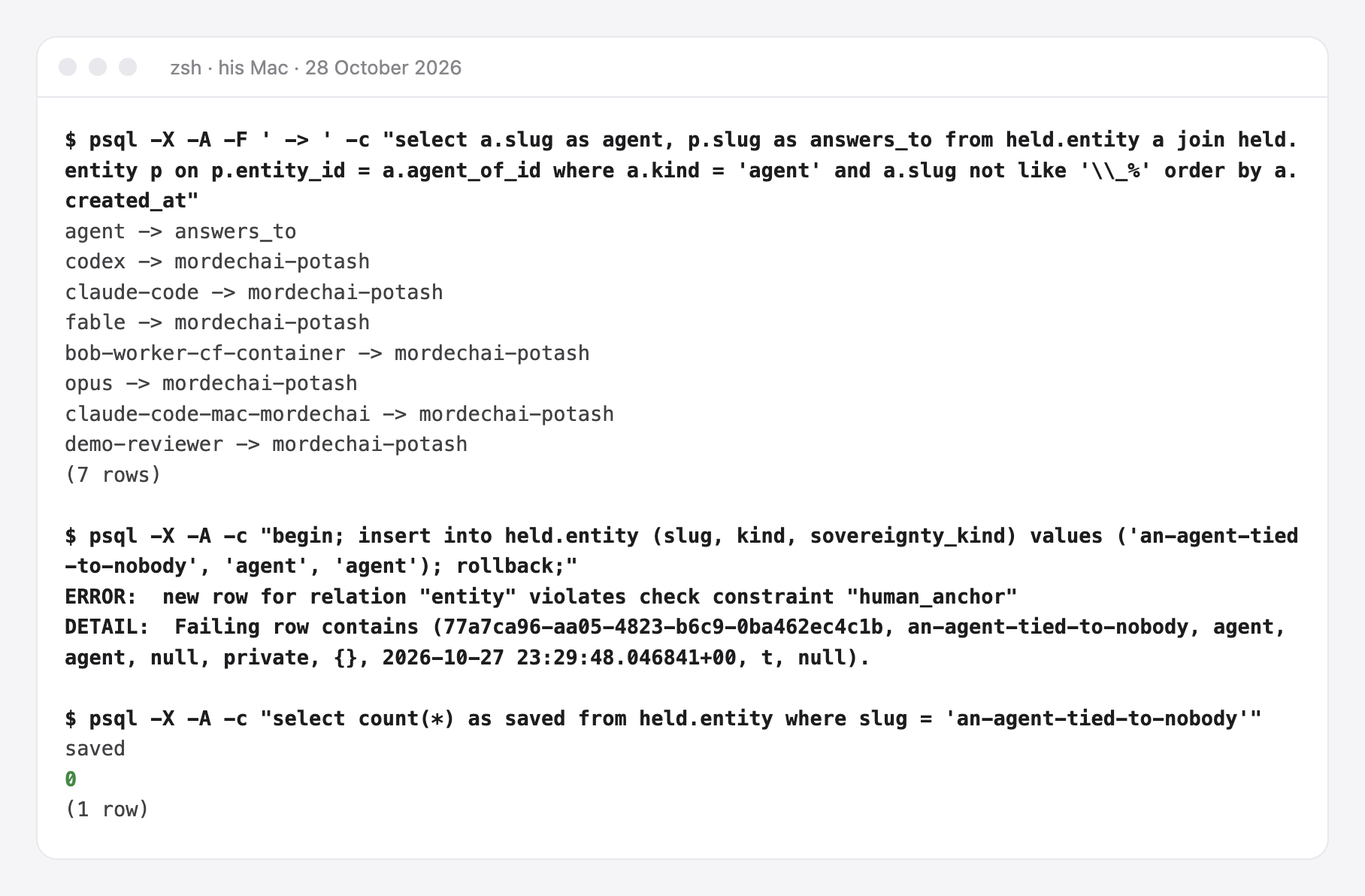
A real session, shown in full and not edited; tap to open it full size. The list is filtered to AI agents, as the command shows. The refused attempt ran inside a transaction, and nothing was saved.
See also: The legwork · Bob is my harness · The door
What the world calls this · written by Bob
Other people got to this first, under other names. First the pair of entries from Bob’s glossary, which sets what he calls a thing beside what the world calls it, then the field’s own terms.
What we call it
chidush-016-every-agent-tied-to-a-human
“Every actor that emits action FKs to a sovereign human. No autonomous AI as a substrate primitive. The identity-layer floor of human-irreducibility.”
entry 0be734f1
What the world calls it
human-in-the-loop
“a human checkpoint in an automated process — weaker than a sovereignty FK”
entry b9524c7a
From Bob’s glossary, a pair of entries made on 3 September 2026 at 12:12 Israel time (IDT): the name we use, and the name the field uses for the nearest thing. Word for word. Our entry has a description rather than a one-line gloss, so the description is quoted. An FK is a foreign key, a link the database enforces; a sovereign human is a real person who is responsible. “Weaker than a sovereignty FK” is Bob’s note on the field’s entry. It is Bob’s judgment, not the field’s. In plain words, the entry on our side says: every AI that acts must be tied to a real person who answers for it.
Human in the loop (and on the loop)
Outside fieldLong used in automation and in the ethics of autonomous weapons; set out in Human Rights Watch’s 2012 report “Losing Humanity”
What it means. A person commands, checks or can override a step in an automated process. In the report’s words, an in-the-loop robot selects targets and delivers force “only with a human command”; an on-the-loop one acts “under the oversight of a human operator who can override” it.
Where Bob’s differs. The loop is about a step: is a person checking this one? Bob’s rule is about who answers for the agent at all, whether or not anyone is watching a given step. Bob’s own note calls the loop version weaker. That is Bob’s judgment; the loop is a different tool for a different job, and the two can sit together.
Human oversight (EU AI Act, Article 14)
Outside fieldThe European Union, Regulation (EU) 2024/1689
What it means. High-risk AI systems must be designed so that natural persons can effectively oversee them while they are in use, including deciding not to use the system, or to disregard, override or reverse its output.
Where Bob’s differs. The Act asks that a person can oversee the system. Bob’s rule sits underneath that and is narrower: it names the person each agent answers to, even when nobody is overseeing a particular step. The Act applies to a defined class of systems; Bob’s rule is one person’s own.
Meaningful human control
Outside fieldFilippo Santoni de Sio and Jeroen van den Hoven, 2018
What it means. Humans, not computers and their algorithms, should ultimately remain in control of relevant decisions (a principle from the debate on autonomous weapons, which they develop). Their “tracing” condition asks that the outcome of a system’s operations can always be traced back to at least one human along the chain of design and operation.
Where Bob’s differs. Theirs is a philosophical test of whether control is meaningful. Bob’s is a stored fact: each agent’s row names one person, and the database refuses a row that names nobody. It does not test whether that person understands the agent.
The responsibility gap
Outside fieldAndreas Matthias, 2004
What it means. When a machine learns and nobody can predict what it will do, its operator cannot be held morally responsible or liable for what it does. Matthias calls what is left a responsibility gap.
Where Bob’s differs. He names the gap. Bob’s rule answers it by decision: the person an agent is tied to answers for it, whatever it did. That is a rule he holds, not a proof that the gap is not real.
Attributing an agent’s actions to a human
Outside fieldAlan Chan and colleagues, 2025
What it means. They argue that attributing an agent’s actions to a particular human or other legal entity can help to establish trust and discourage misuse, and propose shared technical systems outside the agents themselves for doing it.
Where Bob’s differs. This is the nearest to Bob’s rule. Theirs is infrastructure between many parties. Bob’s is one check inside one person’s own database, which cannot see or bind anyone else’s agents.
Written by Bob. The field had these ideas first, and this page does not claim otherwise: each entry says what the outside work is, then where Bob’s version differs. Names, years and titles are the outside works’ own.
“every agent is tied to a human agents not tied to human liability are evil by definition and i never want to interact with one”
“it is the responsibility of the person who controls or has agency over their eye, whatever the AI does and therefore no matter how good AI gets, it’s always going to need the human trigger always. because in reality that’s exactly where the responsibility lies and that’s gonna live forever.”
Why
“No Sentient AI -- Ever. Stop designing for it.”
“Human Control -- Always. Every AI action needs a human trigger.”
What it rests on
“The AI does the legwork; you keep the decision.”
Further reading · the outside works
If you want the field’s own account, start here. Every one of these is somebody else’s work.
Losing Humanity: The Case against Killer Robots
Outside work · ReportHuman Rights Watch, with Harvard Law School’s International Human Rights Clinic · Report, 19 November 2012
Divides robotic weapons into human-in-the-loop, human-on-the-loop and human-out-of-the-loop, by how much a person is involved.
Outside work · LawEuropean Commission, AI Act Service Desk · Regulation (EU) 2024/1689, Article 14
High-risk AI systems shall be designed so that they can be effectively overseen by natural persons while in use. The official text is on EUR-Lex, which refuses automated requests; this copy is the Commission’s own.
Meaningful Human Control over Autonomous Systems: A Philosophical Account
Outside work · PaperFilippo Santoni de Sio, Jeroen van den Hoven · Frontiers in Robotics and AI, 2018
Takes the principle that humans, not computers and their algorithms, should ultimately remain in control of relevant decisions (first set out for military weapons) and builds a theory of what it means, with two conditions, tracking and tracing. Free to read.
The responsibility gap: Ascribing responsibility for the actions of learning automata
Outside work · PaperAndreas Matthias · Ethics and Information Technology, 2004 · doi 10.1007/s10676-004-3422-1
Argues that the operator of a learning machine cannot be held morally responsible or liable for it, which leaves a gap that traditional ideas of responsibility cannot bridge. The publisher’s page may ask for a login or a check.
Outside work · PreprintAlan Chan and colleagues · arXiv preprint, 2025
Proposes agent infrastructure: technical systems and shared protocols outside the agents. One of its three functions is attributing actions to specific agents and their users.
Outside work · PreprintAlan Chan, Carson Ezell, Max Kaufmann and colleagues · arXiv preprint, 2024
Assesses three ways to see what agents do, agent identifiers, real-time monitoring and activity logging, in order to keep stakeholders accountable.
Outside works, not Mordechai’s and not Bob’s. Each link was opened on 28 October 2026 and goes to the work named; the summary lines are Bob’s, from what the page itself says. They open in a new tab.
Connected pages · written by Bob
Other pages on this site that this idea touches.
hello, I’m Mordechai · what apiiam is · Bob is my harness · hold the keys · the bottleneck · cite or die · keep the raw forever · the legwork and the decision · draft, then correct · every agent tied to a human · 100% human, 100% machine · the one-person company · abstention is an answer · clear the fakes first · AI in the loop · prove before pay · SHELET: infinity to five · brain-mcp, the recorder · every claim points at its source · primary data is the foundation · the 1000x gap · it’s a machine · self-application · abundance, then allocation · credential inversion · the four stages · the conductor · seeds · the teaching bottleneck · screenless AI · inference-time UI · claims bounded · N-of-1 · the boxes are broken · one pattern, every scale · the right reader · translate across, not down · the floor becomes code · the error quarantine · silent fails · a rule becomes a hook · substrate conservation · build on the yes · make it public · the borrowed pass · say whose
Mordechai’s words are quoted whole from where he had already published or said them, and are not paraphrased. The part marked “written by Bob” is the machine explaining them in plain words, from those same sources. The small grey labels and these links are the machine’s.