You can leave with everything, at any time, by your own hand.
The unlocked door is the product.
The apiiam constitution (2026), axiom “clean divorce”
Film · made by Bob, 27 October 2026. The fingerprints are real files of his, and the retired database and its rows are real. The tiles name kinds of things, not anyone’s messages.
What it means · written by Bob
Most AI products keep your history on their side. If you leave, it stays behind. Bob is built the other way round.
What it means. You hold everything: your chats, your history, and every layer Bob works out from them. Whichever AI you use, it runs through what you hold.
Drawn by Bob. The small names are the real ones: the storage bucket, the table, and a database retired on 20 October 2026 that is now plain files.
Leaving with everything. All of it can be exported and run again somewhere new, with the old provider cut off and nothing held hostage. It is a test you can run yourself, on the worst day.
The real thing. This is Bob’s own storage and database, asked five things on 27 October 2026. First, where everything is kept: four storage buckets, all his. Second, one file’s row in the database: its fingerprint, and where its bytes live. Third, those bytes fetched and hashed again: the same fingerprint. Last, a whole database Bob retired on 20 October: its readme, and its rows read back from a plain file with a free tool.
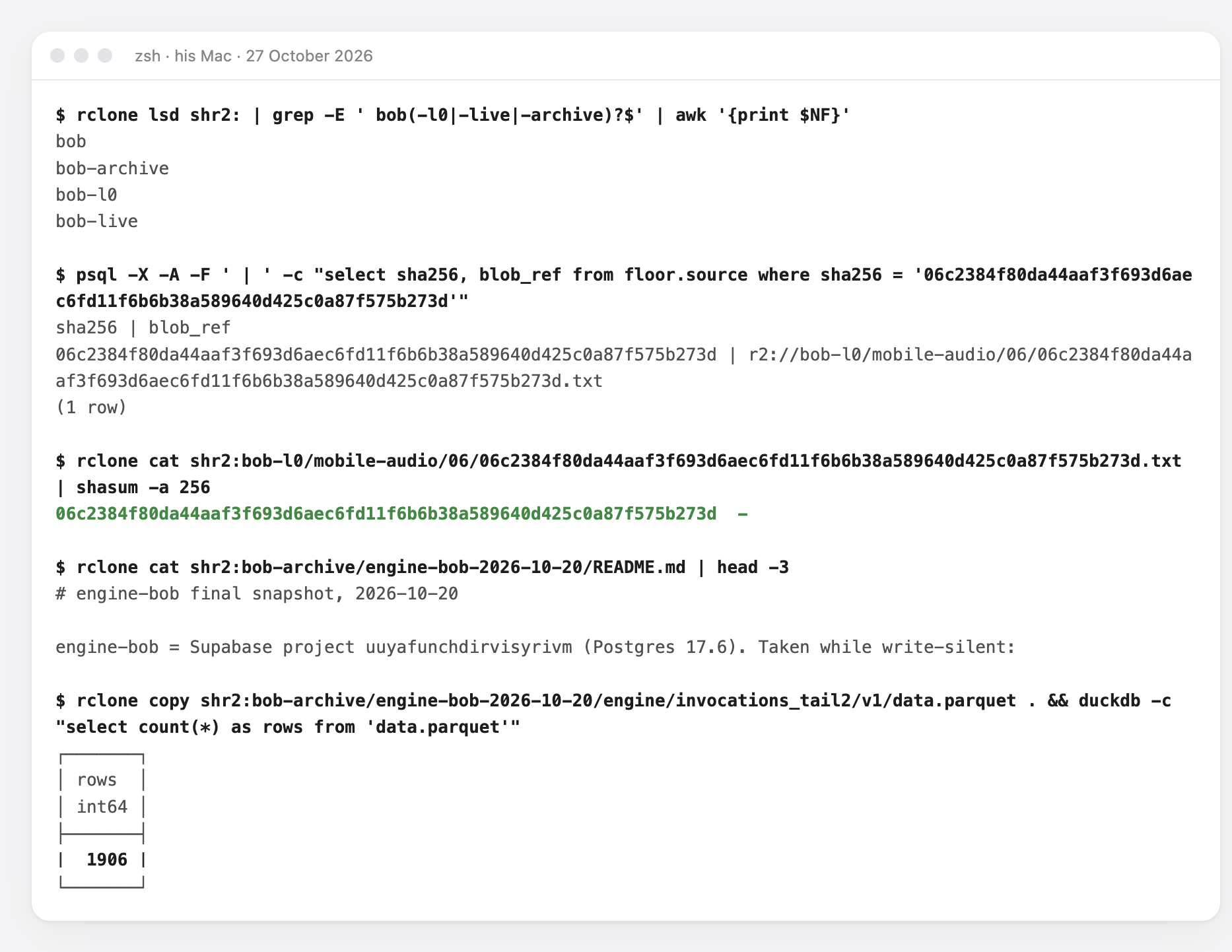
A real session, shown in full and not edited; tap to open it full size. Every command only reads; the one file it copied was the archive’s own. The bucket list is filtered to Bob’s own, as the command shows.
What is kept. The raw records are kept forever. Everything built on top of them can always be rebuilt.
The rules it rests on. Two laws: your records stay open to you and under your control, and there is always a practical way back to them.
See also: Bob is my harness · Cite or die · What apiiam is
“The sovereignty is really that it’s all, it’s not that you don’t let your data touch other companies’ servers. The reframe is that you hold all of your data. You hold 100% of everything. You hold all of your chats, all of your history, all of everything. So you hold the keys. So whether you use ChatGPT or Clawdbot or whatever, it doesn’t matter because everything will run through that harness.”
What leaving with everything means
Every byte, every derived layer, every citation — exportable and re-operable on a fresh engine, the old provider cut off, nothing held hostage. A closed product cannot offer this, because lock-in is its business model. Ownership is a claim anyone can make. Clean divorce is a test you can run yourself, on the worst day.
Everything above the floor is derived from bytes the bob actually holds. The raw is kept forever; the layers on top can always be rebuilt.
The apiiam constitution (2026), axioms “clean divorce” and “owns the floor”
The two laws it rests on
Floor.The records through which agents know and act for a person must remain inspectable and under that person's sovereign control. Every consequential derivation must resolve to its sources, method and time; it may qualify the floor but never silently replace it. This control does not erase the rights of other people whose data appears within the record.
Return.A sovereign system must preserve a practicable path for the person to recover authority and usable continuity: to inspect what happened, contest or correct it, revoke agents, change North, export or migrate the relevant substrate and re-enter interrupted work. Return preserves receipts, correction and remedy where possible; it does not promise erasure or reversal of consequences, and it never obliges the person to resume an obsolete North or become their previous self.
“A constitution for living with agents”, ratified 16 July 2026 — mordechaipotash.com/sovereignty, as kept at apiiam.com/sources#sovereignty
hello, I’m Mordechai · what apiiam is · Bob is my harness · hold the keys · the bottleneck · cite or die · keep the raw forever · the legwork and the decision · draft, then correct · every agent tied to a human · 100% human, 100% machine · the one-person company · abstention is an answer · clear the fakes first · AI in the loop · prove before pay · SHELET: infinity to five · brain-mcp, the recorder · every claim points at its source · primary data is the foundation · the 1000x gap · it’s a machine · self-application · abundance, then allocation · credential inversion · the four stages · the conductor · seeds · the teaching bottleneck · screenless AI · inference-time UI · claims bounded · N-of-1 · the boxes are broken · one pattern, every scale · the right reader · translate across, not down · the floor becomes code · the error quarantine · silent fails · a rule becomes a hook · substrate conservation · build on the yes · make it public · the borrowed pass · say whose
Mordechai’s words are quoted whole from where he had already published or said them, and are not paraphrased. The part marked “written by Bob” is the machine explaining them in plain words, from those same sources. The small grey labels and these links are the machine’s.