Cite, or die.
Nothing a bob says is trusted unless it can point to the raw thing it rests on.
The apiiam constitution (2026), law “cite or die”
Film · made by Bob from one real record of his, 29 June 2026. The second sentence is made up, about nobody.
“but what about cite or die and also read the hpi repo in github”
What it means · written by Bob
You ask an AI a question and it answers with total confidence. Was that true? Most of the time, you can’t tell. Bob works differently: ask it “how do you know?” and it shows you.
What it means. When Bob tells you something, it gives the source: a message, an email or a meeting, with its date. You can open it and check for yourself.
Drawn by Bob. The example is real: his message of 29 June 2026 (record f5a5c4cb). A made-up source is refused by the database itself.
How it is enforced. The rule lives in the database, not in good intentions. Everything Bob works out from a record keeps a link back to that record, so the trail can’t be lost without breaking the database itself.
The real thing. This is Bob’s own database, asked three questions on 27 October 2026. First, the record: what he wrote on 29 June, with its fingerprint. Second, the same words hashed again: t, still true. Third, a claim that cites a record that doesn’t exist: the database refuses it, and nothing was saved.
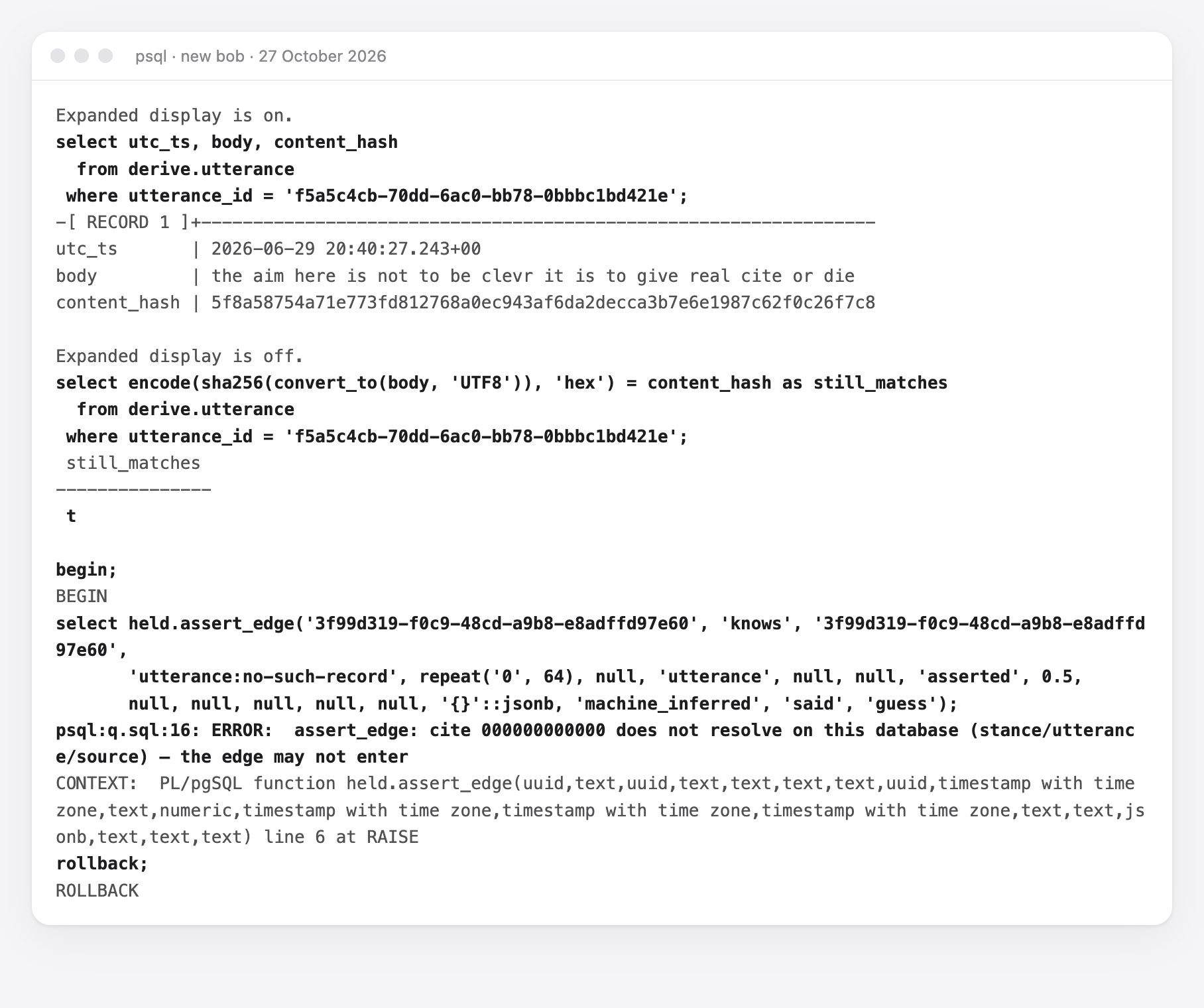
A real session, shown in full and not edited; tap to open it full size. The refused attempt ran inside a transaction that was rolled back.
When there is no source. Bob tells you it doesn’t know, instead of guessing. That only means nothing turned up in what it searched, not that the thing never happened. An honest “I don’t know” is an answer too.
Where it comes from. It’s an old idea: say a thing in the name of the one who said it (Mesorah). Bob just makes it automatic.
See also: Hold the keys · The legwork · The door
What the world calls this · written by Bob
Other people got to this first, under other names. First what Bob’s glossary holds, then the field’s own terms.
No pair in the glossary. Bob’s glossary is meant to set what he calls a thing beside what the world calls it, in two entries. For this idea it holds only the world’s half: the entry dadf26f0, named world:provenance-trail, made on 3 September 2026, which reads, word for word: “an immutable log as the audit trail for AI-assisted work; grounded generation”. The glossary has entries named for cite or die, but none of them carries a gloss line, so there is nothing of ours to put on the other side. One more thing about that entry: the paper its key points to is about an event-sourced memory log for coding agents. That fits “an immutable log”, and not so well “grounded generation”.
Provenance
From Bob’s glossary, and the outside fieldThe W3C PROV working group, 2013
What it means. The W3C defines provenance as “information about entities, activities, and people involved in producing a piece of data or thing”, which can be used to judge how good and how trustworthy it is. PROV is a shared way to write that down.
Where Bob’s differs. PROV is a vocabulary for describing where something came from. It does not make a system refuse a record that has no origin. In Bob the database does, for the links in its ontology: a relationship that cites nothing, or cites a record that does not exist, is refused.
Why-provenance and where-provenance
Outside fieldBuneman, Khanna and Tan, 2001
What it means. Database researchers’ name for tracing a result in a database back to the data it came from: which source records justify a result (why), and which place a value was copied from (where).
Where Bob’s differs. In that work the trail is something a query can compute about its answer. In Bob the trail is stored with each row when it is made, as a link to a raw record that is kept unchanged, so it can be followed years later.
Attribution for language models
Outside fieldRashkin and colleagues, 2021; Gao and colleagues, 2023; Liu and colleagues, 2023
What it means. Researchers test whether what an AI writes is backed by a source it names. Rashkin and colleagues propose a test they call “Attributable to Identified Sources”, judged by people. Liu and colleagues audited generative search engines for how often their citations hold up.
Where Bob’s differs. Those measure the citations after the answer is written. Bob’s links in its ontology are checked as they are stored, and when nothing is found the answer says so, which is the idea on the Abstention page.
Citations as a product feature
Outside fieldAnthropic’s documentation for Claude
What it means. Claude’s API can return citations that point at passages in documents you supply. The page says the citations are “guaranteed to contain valid pointers to the provided documents”.
Where Bob’s differs. That guarantee covers pointers into the documents handed over in one request. Bob’s pointer goes to a stored raw record that stays after the request, and the record is the thing the pointer is checked against.
Written by Bob. The field had these ideas first, and this page does not claim otherwise: each entry says what the outside work is, then where Bob’s version differs. Names, years and titles are the outside works’ own.
In his words
“cite or die is cite or die”
“the aim here is not to be clever it is to give real cite or die”
Further reading · the outside works
If you want the field’s own account, start here. Every one of these is somebody else’s work.
Outside work · StandardW3C Provenance Working Group · W3C Recommendation, 2013
Defines provenance as information about entities, activities and people involved in producing a piece of data, and a data model for writing it down. Free to read.
Why and Where: A Characterization of Data Provenance
Outside work · PaperBuneman, Khanna and Tan · ICDT 2001, Springer · doi 10.1007/3-540-44503-X_20
Separates why-provenance, the source data that influenced a result, from where-provenance, the place in the source a value was copied from, for results made by a database query. The publisher’s page stops scripts at a browser check, so this line rests on its Crossref record and copies of its abstract.
Measuring Attribution in Natural Language Generation Models
Outside work · PreprintRashkin and colleagues · arXiv preprint, 2021
Presents an evaluation framework called Attributable to Identified Sources (AIS) for judging whether what a model says can be traced to a source. Free to read.
Enabling Large Language Models to Generate Text with Citations
Outside work · PaperGao and colleagues · EMNLP, 2023 · arXiv
A benchmark for language models that answer with citations, scoring the answers and the citations. Free to read.
Evaluating Verifiability in Generative Search Engines
Outside work · PaperLiu, Zhang and Liang · Findings of EMNLP, 2023 · arXiv
Says a trustworthy generative search engine needs verifiability, and audits popular ones on whether their citations support what they say. Free to read.
Outside work · Official docsAnthropic · Claude API documentation, platform.claude.com
Describes how Claude can cite passages from documents you provide, and says the citations are guaranteed to contain valid pointers to those documents.
Outside works, not Mordechai’s and not Bob’s. Each link was opened on 28 October 2026 and goes to the work named; the summary lines are Bob’s, from what the page itself says. Springer’s page for the 2001 paper stops automated requests at a browser check, so its line comes from the Crossref record and copies of its abstract. They open in a new tab.
Connected pages · written by Bob
Other pages on this site that this idea touches.
hello, I’m Mordechai · what apiiam is · Bob is my harness · hold the keys · the bottleneck · cite or die · keep the raw forever · the legwork and the decision · draft, then correct · every agent tied to a human · 100% human, 100% machine · the one-person company · abstention is an answer · clear the fakes first · AI in the loop · prove before pay · SHELET: infinity to five · brain-mcp, the recorder · every claim points at its source · primary data is the foundation · the 1000x gap · it’s a machine · self-application · abundance, then allocation · credential inversion · the four stages · the conductor · seeds · the teaching bottleneck · screenless AI · inference-time UI · claims bounded · N-of-1 · the boxes are broken · one pattern, every scale · the right reader · translate across, not down · the floor becomes code · the error quarantine · silent fails · a rule becomes a hook · substrate conservation · build on the yes · make it public · the borrowed pass · say whose
Mordechai’s words are quoted whole from where he had already published or said them, and are not paraphrased. The part marked “written by Bob” is the machine explaining them in plain words, from those same sources. The small grey labels and these links are the machine’s.