“The recorder for your AI conversations.”
“Your AI history is being deleted right now.”
Film · made by Bob, 28 October 2026, from what the README says brain-mcp does. The file name and lines are the README’s own example; the short fingerprints and the dates are made up to show the idea.
What it means · written by Bob
Every session you have with an AI coding tool is a record of how your work was decided. Claude Code deletes its own after thirty days, unless you change the setting. brain-mcp keeps them.
What it does. It keeps an exact copy of every session from Claude Code, Codex and Pi, on your own computer, before the tool deletes it. If one was deleted, it can put it back, byte for byte.
How you can trust an answer. Ask it something, and every answer points to the file, the lines and a fingerprint you can check yourself with two standard commands. If nothing is found, it says so, and names what it searched.
Drawn by Bob, from the page’s own sources: the README and its rule that every answer is cited or abstained.
The real thing. This is not brain-mcp itself but Bob, which grew out of it, asked the same way by hand on 28 October 2026. First, a search of his own messages: one from 12 September 2025, with its record id and its date. Second, its fingerprint worked out again from the words: t, still true. Third, a search for a phrase that is not in his record: no rows. The answer is that nothing was found, not a guess.
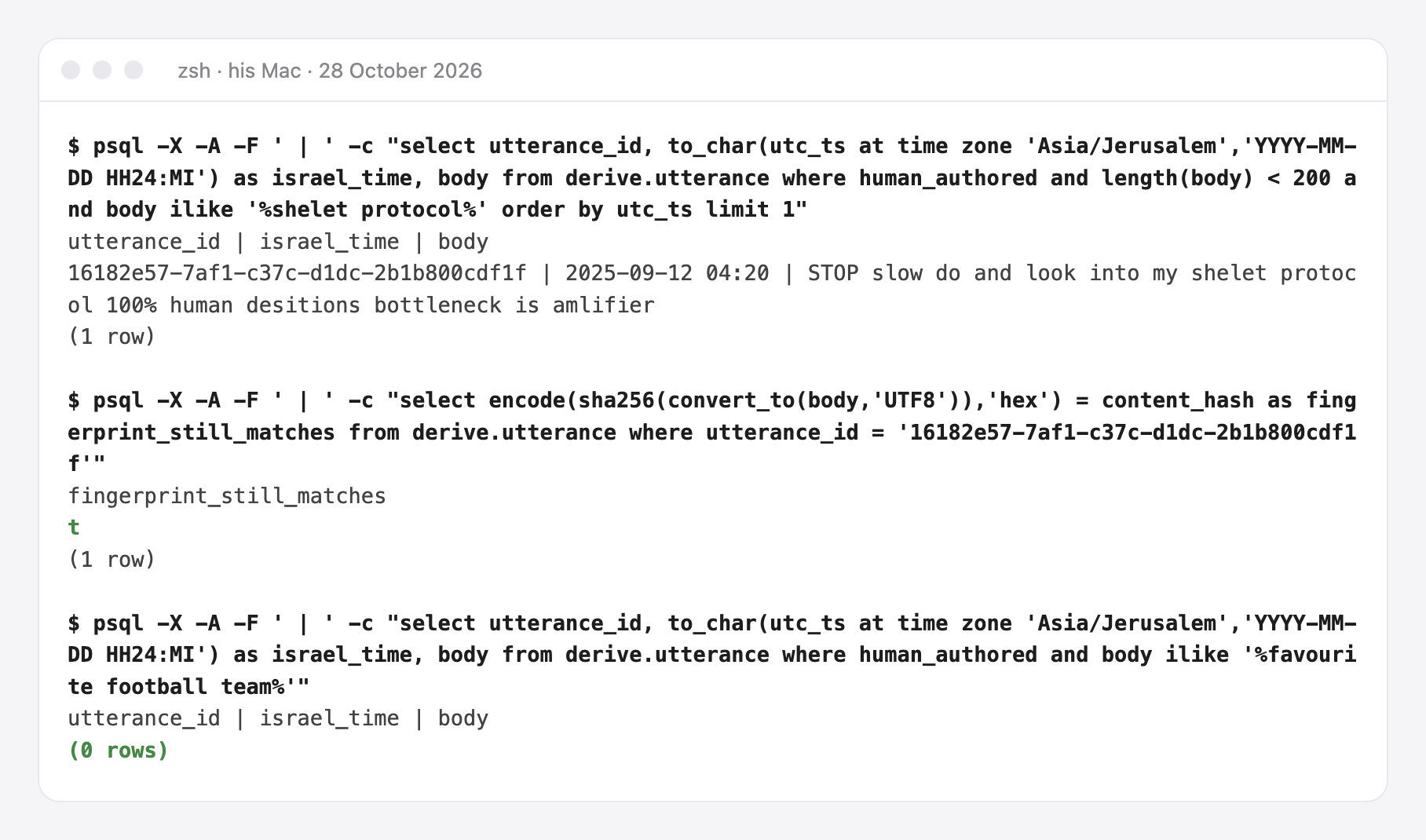
A real session on his Mac, shown in full and not edited; tap to open it full size. Read-only, nothing written. Every search is limited to his own messages, so no one else’s words can appear. Times are Israel time.
What it costs. Nothing. It is open source under the MIT licence and runs on your own computer, with no telemetry, no cloud and no accounts.
Where it led. Bob, the harness these pages describe, grew out of it. brain-mcp keeps your AI chats; Bob holds everything else too.
See also: Hold the keys · Cite or die · Bob is my harness
The code: github.com/mordechaipotash/brain-mcp
“We should basically make a Brain MCP demo that anybody can download and use so that it works out of the box.”
“So basically brainmcp is my power user custom setup opensourced.”
“I know that brain MCP, the whole thing was local on your computer, etc., etc., sovereignty, whatever.”
Published, the README
“The one rule: everything you state from these tools is either CITED or ABSTAINED — there is no third state.”
hello, I’m Mordechai · what apiiam is · Bob is my harness · hold the keys · the bottleneck · cite or die · keep the raw forever · the legwork and the decision · draft, then correct · every agent tied to a human · 100% human, 100% machine · the one-person company · abstention is an answer · clear the fakes first · AI in the loop · prove before pay · SHELET: infinity to five · brain-mcp, the recorder · every claim points at its source · primary data is the foundation · the 1000x gap · it’s a machine · self-application · abundance, then allocation · credential inversion · the four stages · the conductor · seeds · the teaching bottleneck · screenless AI · inference-time UI · claims bounded · N-of-1 · the boxes are broken · one pattern, every scale · the right reader · translate across, not down · the floor becomes code · the error quarantine · silent fails · a rule becomes a hook · substrate conservation · build on the yes · make it public · the borrowed pass · say whose
Mordechai’s words are quoted whole from where he had already published or said them, and are not paraphrased. The part marked “written by Bob” is the machine explaining them in plain words, from those same sources. The small grey labels and these links are the machine’s.