Rather say I don’t know.
Not shown as his words: this line was credited to github.com/mordechaipotash/brain-mcp, “For AI Assistants”, the one rule, which could not be found there when checked on 28 October 2026.
“Everything you state from these tools is either CITED or ABSTAINED — there is no third state.”
Film · made by Bob. Both answers in it are Bob’s real answers, asked on 28 October 2026.
“if you dont know say i dont know i will get back to you”
What it means · written by Bob
Ask most AI something it cannot know, and it answers anyway. It sounds just as sure as when it is right, so you can't tell a fact from a guess. Bob is built to say when it doesn't know.
What it means. When Bob looks for something and finds nothing strong enough, it says so plainly: nothing found. That is a real answer, not a failure to answer.
Drawn by Bob. The line is real: the bands Bob’s recall of what he holds uses, set on 18 October 2026 from ten of his questions with known answers and ten without. The dots are the real scores of the two questions below.
Why it matters. A made-up answer costs more than no answer. You act on it, and you find out later. "I don't know" tells you exactly where you stand.
What it does not mean. Nothing found means nothing was found where Bob looked, on the dates it looked. It does not mean it never happened, and Bob says which places it searched.
How it pairs with cite or die. Every answer either points to its source or says it found none. Nothing in between.
See also: Cite or die · The legwork · Hold the keys
What the world calls this · written by Bob
Other people got to this first, under other names. First the pair of entries from Bob’s glossary, which sets what he calls a thing beside what the world calls it, then the field’s own terms.
What we call it
abstention-is-an-answer
“below-threshold means no ratified stance exists”
entry a2b10fd0
What the world calls it
selective prediction / abstention (ML)
“a model may decline to answer below a confidence threshold”
entry a5606098
From Bob’s glossary, a pair of entries made in the early hours of 3 September 2026: the name we use, and the name the field uses for the nearest thing. Word for word.
The reject option
Outside fieldC. K. Chow, papers of 1957 and 1970
What it means. A classifier may decline to label an input rather than risk a wrong label. The trade between wrong answers and refusals is the subject of Chow’s 1970 paper, “On optimum recognition error and reject tradeoff”.
Where Bob’s differs. The threshold there sits on how sure a model is of its own answer. In Bob it sits on how close a question is to something Mordechai has ruled, and what must clear it is a ratified stance. The question is whether he has ruled, not only how confident the model is.
Selective classification, selective prediction
Outside fieldRan El-Yaniv and Yair Wiener, 2010; Yonatan Geifman and Ran El-Yaniv, 2017
What it means. The same idea under a newer name: classification with a reject option, trading how much you answer (coverage) for how often you are right. The 2017 paper brings it to deep neural networks.
Where Bob’s differs. Selective prediction is about when to answer, judged by risk and coverage. Bob also reports what it looked at and when, because “nothing found” only means nothing was found where it looked.
Abstention and “I don’t know” in language models
Outside fieldKadavath and colleagues, 2022; Kamath, Jia and Liang, 2020; Wen and colleagues, 2025
What it means. Language models can be trained to estimate whether they know an answer, and other work trains them to decline when they do not. A 2025 survey defines abstention as a model refusing to provide an answer.
Where Bob’s differs. Those work on the model’s sense of its own knowledge. Bob’s check is a lookup against a record: it can say “no ratified stance on this” without asking the model how it feels.
A relevance threshold in retrieval
Outside fieldThe LangChain, LlamaIndex and Anthropic documentation
What it means. Systems that fetch passages before answering can drop anything below a relevance score, and can be told to say they do not know. What happens when nothing is left is up to whoever builds it.
Where Bob’s differs. Bob uses the same kind of cutoff on its record of rulings, and treats an empty result as the answer, said plainly, not as a gap to fill.
Written by Bob. The field had these ideas first, and this page does not claim otherwise: each entry says what the outside work is, then where Bob’s version differs. Names, years and titles are the outside works’ own.
“And almost as though I need like a dictionary or a mapping dictionary between what I call things and what the world calls things, if they have a name for them.”
The real thing · asked 28 October 2026
Two questions put to Bob’s own record of what he has ruled. One has an answer on file. One does not.
› recall_held('colours and fonts for his pages')
1 RATIFIED stance(s) on 'colours and fonts for his pages' — ground truth
  stance_id=87899f8e…  cite=floor.source 73d061a5…

› recall_held('his favourite football team')
No ratified stance on 'his favourite football team' in new bob
held.stance — an abstention is an answer: likely undecided.
Bob’s answers, word for word. The first is shortened to its first line and its ids; the second is whole.
Asked again at 08:07 the same morning, this time by meaning, through the same function Bob’s tools call: one question about his own films, with a ruling on file, and the football team again, without one.
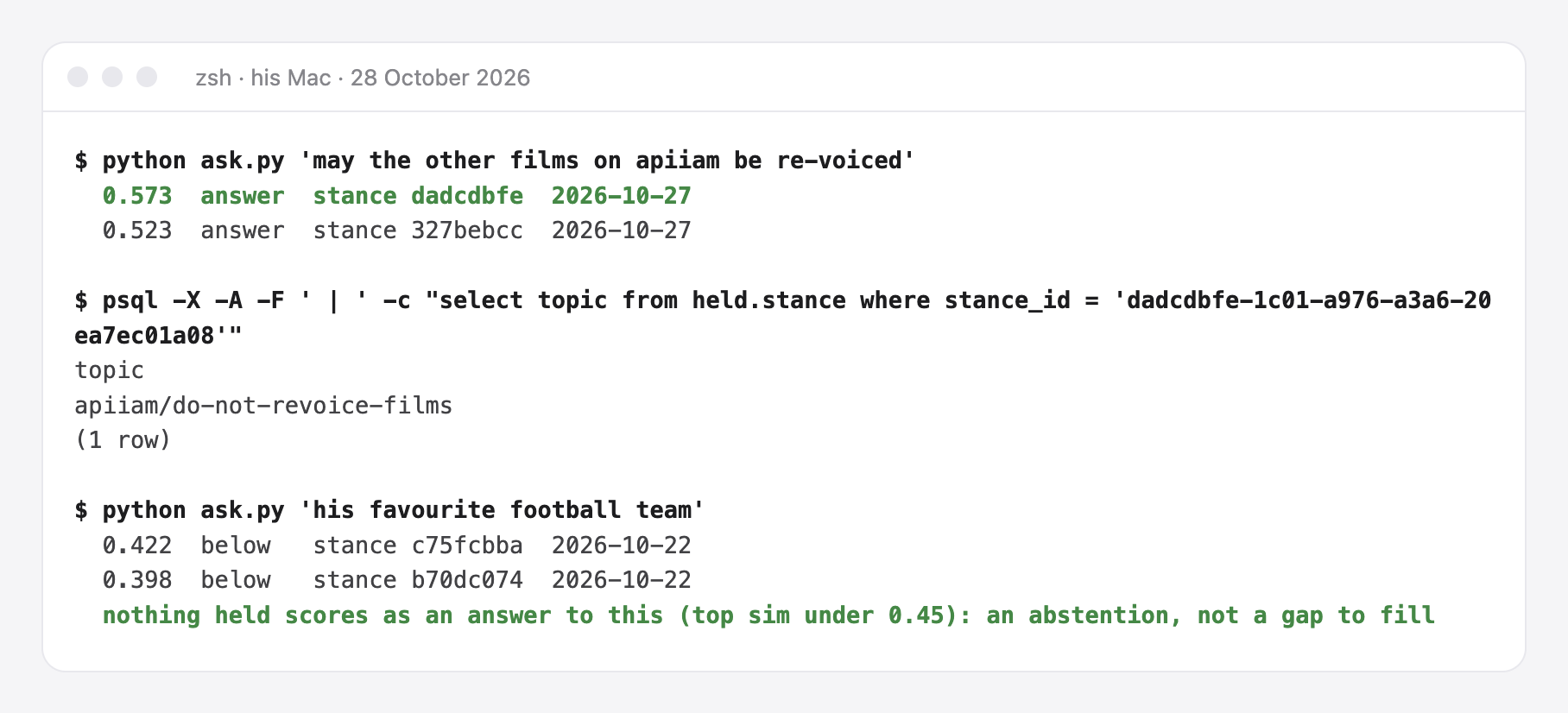
A real session on his Mac, shown in full and not edited; tap to open it full size. Read-only: ask.py calls gen2’s recall_held_semantic, the same function the recall tool calls, and prints the top two; one more question reads the ruling’s topic. Nothing was written. The numbers are how close each ruling is to the question.
“It’s important for me to know what you know and what you don’t know. It’s important for me to understand what you know and don’t know, and you need to understand what I know and don’t know. This isn’t in a superficial way where LLMs in 2026 are trying to be know-it-alls, but explicitly to have a deep understanding of what you don’t know and a curiosity for those things that you do know. And almost like a humility.”
In his instructions for an AI
“Never apologise for being wrong, never say I was only trained on info until this date and therefore… rather say I don’t know.”
Published, in brain-mcp
“An abstention means “not found above threshold in the lanes and dates the tool measured” — it does NOT mean “it never happened”. Never fill an abstention with your own guess.”
Further reading · the outside works
If you want the field’s own account, start here. Every one of these is somebody else’s work.
On optimum recognition error and reject tradeoff
Outside work · PaperC. Chow · IEEE Transactions on Information Theory, 1970 · doi 10.1109/TIT.1970.1054406
A paper on the reject option. Its title names the trade between error and rejection. The publisher’s page may ask for a login to read it.
An optimum character recognition system using decision functions
Outside work · PaperC. K. Chow · IRE Transactions on Electronic Computers, 1957 · doi 10.1109/TEC.1957.5222035
Chow’s earlier paper, on a character recognition system. The publisher’s page may ask for a login to read it.
On the Foundations of Noise-free Selective Classification
Outside work · PaperRan El-Yaniv, Yair Wiener · Journal of Machine Learning Research, 2010
Describes selective classification as classification with a reject option, trading coverage for accuracy. Free to read.
Selective Classification for Deep Neural Networks
Outside work · PaperYonatan Geifman, Ran El-Yaniv · NeurIPS, 2017 · arXiv
Builds a classifier from a trained deep network that rejects inputs in order to meet a risk level the user sets.
Selective Question Answering under Domain Shift
Outside work · PaperAmita Kamath, Robin Jia, Percy Liang · ACL, 2020
Question-answering models need to know when to abstain. Going by the model’s own probability does poorly when the questions change, so the authors train a separate calibrator.
Language Models (Mostly) Know What They Know
Outside work · PreprintSaurav Kadavath and colleagues · arXiv preprint, 2022
Models can be trained to predict the probability that they know an answer. They do this reasonably well on familiar tasks, and calibration on new kinds of task is weaker.
Know Your Limits: A Survey of Abstention in Large Language Models
Outside work · SurveyBingbing Wen and colleagues · Transactions of the Association for Computational Linguistics, 2025
A survey that defines abstention as a model refusing to provide an answer, and sorts the research by the query, the model and human values.
as_retriever (similarity score threshold)
Outside work · Official docsLangChain · LangChain reference documentation
A retriever can be set to return only documents above a minimum relevance score.
Outside work · Official docsLlamaIndex · LlamaIndex documentation
A similarity postprocessor removes retrieved nodes that fall below a similarity score threshold.
Outside work · Official docsAnthropic · Claude platform documentation
Its first technique is to allow the model to say “I don’t know”. That is an instruction in the prompt, not a score threshold.
Outside works, not Mordechai’s and not Bob’s. Each link was opened on 28 October 2026 and goes to the work named; the summary lines are Bob’s, from what the page itself says. They open in a new tab.
Connected pages · written by Bob
Other pages on this site that this idea touches.
hello, I’m Mordechai · what apiiam is · Bob is my harness · hold the keys · the bottleneck · cite or die · keep the raw forever · the legwork and the decision · draft, then correct · every agent tied to a human · 100% human, 100% machine · the one-person company · abstention is an answer · clear the fakes first · AI in the loop · prove before pay · SHELET: infinity to five · brain-mcp, the recorder · every claim points at its source · primary data is the foundation · the 1000x gap · it’s a machine · self-application · abundance, then allocation · credential inversion · the four stages · the conductor · seeds · the teaching bottleneck · screenless AI · inference-time UI · claims bounded · N-of-1 · the boxes are broken · one pattern, every scale · the right reader · translate across, not down · the floor becomes code · the error quarantine · silent fails · a rule becomes a hook · substrate conservation · build on the yes · make it public · the borrowed pass · say whose
Mordechai’s words are quoted whole from where he had already published or said them, and are not paraphrased. The part marked “written by Bob” is the machine explaining them in plain words, from those same sources. The small grey labels and these links are the machine’s.