First, know who is human.
Step 1 = Sur Mera (prove human, remove fakes). Step 2 = Asey Tov (build HPI).
Not shown as his words: these two lines were credited to github.com/mordechaipotash/shelet-thesis, chidush 008, which could not be found there when checked on 28 October 2026.
Film · made by Bob. A drawing: the sender name and the masked numbers are made up, about nobody. The rule it shows is the one Bob runs.
“i remember it being a human identification layer”
“in a world of accelarating ability to deepfake iamwhoiam is an imutable human passport id resume and buck stops here human accountability layer”
What it means · written by Bob
More and more of what reaches you is sent by software, and some of it is dressed as a person. Before a system does anything personal for someone, it has to know that someone is real, and that they are who they say.
What it means. Sur mera, then asei tov: turn from bad, then do good. First clear out what is fake. Only then build what is good for the person who is left.
Why the order matters. Personal service built for a fake serves the wrong one. So knowing who is human comes first, and everything personal is built on top of it.
How Bob does it. Bob matches a person by something hard, a phone number or an email address, never by the name on the screen. A few numbers were first tied to their person on the evidence of a display name; Bob keeps those as its weakest kind of match, marked as such. A sender it cannot match stays marked unknown, kept apart, until a human rules who they are. Nothing is guessed.
Drawn by Bob. The rule is the one Bob runs; the 43 is a real count, made on 28 October 2026 (below). No name or number is drawn.
What comes after. Once Bob knows who someone is, it can work for them personally: their history, their words, their way of working. That is the API that is you.
See also: Every agent tied to a human · What apiiam is · Cite or die
What the world calls this · written by Bob
Other people got to this first, under other names. First the pair of entries from Bob’s glossary, which sets what he calls a thing beside what the world calls it, then the field’s own terms.
What we call it
keys-over-names-nothing-below-1-writes
“identity lives in channel keys; nothing below 1.0 writes an edge, it writes a proposal”
entry c6bf4ee9
What the world calls it
deterministic-first-entity-resolution
“keep identity matching deterministic and explainable; use the LLM the opposite way”
entry 69c285eb
From Bob’s glossary, a pair of entries made on 3 September 2026 (both at 12:12 Israel time, IDT): the name we use, and the name the field uses for the nearest thing. Word for word. In plain words: a channel key is a phone number, an email address or a messaging id; an edge is a recorded link from a sender to a person; 1.0 is full certainty. The world’s entry names two outside works as its keys. One is a vendor’s blog post that does say this. The other, a 2026 paper on fine-tuning a language model to match names, argues for the opposite, so it is not used here as support.
Entity resolution, record linkage
From Bob’s glossary, and the outside fieldNewcombe and colleagues, 1959; Fellegi and Sunter, 1969
What it means. Deciding which records, from one source or several, refer to the same real thing, here the same person. An early paper on linking records by machine is from 1959, in Science, and the standard statistical theory, which Splink’s documentation says its own method is based on, is from 1969.
Where Bob’s differs. Their question is how likely two records are to be the same. Bob asks a smaller one first: do they share a hard key? If so, they are linked. If not, the sender stays unknown, kept apart, until he rules.
Deterministic versus probabilistic matching
Outside fieldThe Splink documentation (UK Ministry of Justice)
What it means. Splink’s guide calls deterministic linkage rules-based, with exact-match rules, and probabilistic linkage evidence-based: it weighs several features and gives a probability that two records match.
Where Bob’s differs. Bob is deterministic first on purpose, and its own gloss says nothing below full certainty writes a link; it writes a proposal for a human. A display name is not a key: the page counts 43 display names that more than one number uses.
Language models as matchers
Outside fieldPeeters and Bizer, 2023; a vendor’s blog post, 2025
What it means. Peeters and Bizer found ChatGPT competitive with a fine-tuned RoBERTa model at deciding whether two records are the same thing. A vendor’s blog post (Tilores, from a company that sells entity resolution, so a sales argument and not research) says to resolve identities first with deterministic rules, then let the model work with the one resolved person.
Where Bob’s differs. Bob takes the second view. A model may propose a match, and a proposal is all it writes. Only a hard key or his ruling makes a link.
The Sybil attack, and knowing who is a distinct person
Outside fieldDouceur, 2002
What it means. Douceur argues that without a trusted way to tell who is who, one party can pose as many. The paper’s requirement is in his words: “The system must ensure that distinct identities refer to distinct entities.”
Where Bob’s differs. His problem is forged identities in open networks. This page’s first step, prove human and remove fakes, is the same worry in one person’s inbox: messages sent by software dressed as a person. Bob does not prove anyone human by itself; an unmatched sender waits for him to rule.
Written by Bob. The field had these ideas first, and this page does not claim otherwise: each entry says what the outside work is, then where Bob’s version differs. Names, years and titles are the outside works’ own.
The real thing · measured 28 October 2026
In the 30 days before, Bob matched 1,927 of 2,791 WhatsApp messages and 453 of 1,162 emails to a known person, by number or by address. The rest are kept, marked unknown, until he rules who sent them.
Counted by Bob on its own messages table. No sender is named here.
Counted again at 08:07 the same morning, with the hard keys Bob matches on and the reason a name is not one of them. The 30-day window had moved by then, so the totals differ by a few.
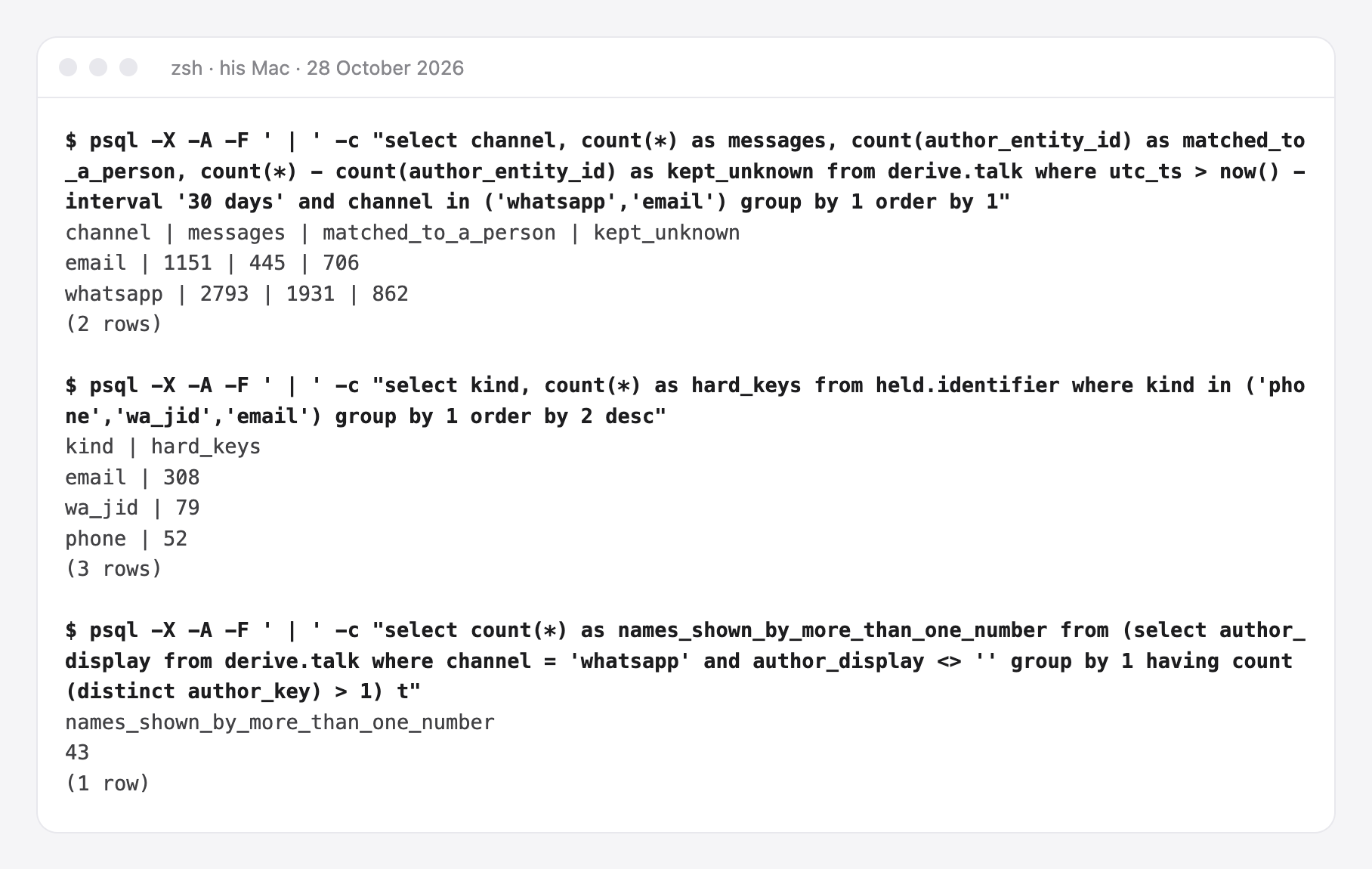
A real session on his Mac, shown in full and not edited; tap to open it full size. Read-only, and counts only: no name, number, address or message is selected. The hard keys are filtered to the three kinds Bob matches senders on: email addresses, WhatsApp ids and phone numbers.
“As agents and robots exponentially explode it is IMPERATIVE to have know who is human.”
“Now that we 1. know who is human 2. we can start building a HPI, a unique hyperpersonalised API for that user.”
Further reading · the outside works
If you want the field’s own account, start here. Every one of these is somebody else’s work.
Automatic Linkage of Vital Records
Outside work · PaperNewcombe and colleagues · Science, 16 October 1959 · doi 10.1126/science.130.3381.954
The title names the task: linking records by machine. The publisher’s page refuses automated readers, so this line rests on the title and its Crossref record.
Outside work · PaperFellegi and Sunter · Journal of the American Statistical Association, December 1969 · doi 10.1080/01621459.1969.10501049
The statistical theory of record linkage that later tools build on; the Splink documentation says its algorithm is based on it. The publisher’s page refuses automated readers, so this line rests on the title, the Crossref record and Splink’s page.
Splink: fast, accurate and scalable probabilistic data linkage
Outside work · Project docsUK Ministry of Justice, analytical services · Splink documentation
Open-source software for linking and deduplicating records that have no unique identifier, built on the Fellegi–Sunter model. A companion page sets deterministic linkage beside probabilistic. Free to read.
Using ChatGPT for Entity Matching
Outside work · PaperPeeters and Bizer · ADBIS, 2023 · arXiv
Tests ChatGPT as a matcher of records and reports it competitive with a fine-tuned model. Free to read.
Can LLMs be used for Entity Resolution?
Outside work · Vendor blogTilores · tilores.io, 3 November 2025
A company that sells entity resolution argues for deterministic, explainable resolution first, with the language model working on the resolved identity. A sales argument, and it is the one that fits Bob’s glossary entry.
Outside work · PaperDouceur · Peer-to-Peer Systems (IPTPS 2002), Springer · doi 10.1007/3-540-45748-8_24
Argues that without a trusted identification authority, one party can forge many identities. Springer’s page may stop you at a browser check; a free copy of the paper is kept at freehaven.net.
Outside works, not Mordechai’s and not Bob’s. Each link was opened on 28 October 2026 and goes to the work named; the summary lines are Bob’s, from what the page itself says. The two older papers refuse automated requests, so their lines come from the Crossref record. They open in a new tab.
Connected pages · written by Bob
Other pages on this site that this idea touches.
hello, I’m Mordechai · what apiiam is · Bob is my harness · hold the keys · the bottleneck · cite or die · keep the raw forever · the legwork and the decision · draft, then correct · every agent tied to a human · 100% human, 100% machine · the one-person company · abstention is an answer · clear the fakes first · AI in the loop · prove before pay · SHELET: infinity to five · brain-mcp, the recorder · every claim points at its source · primary data is the foundation · the 1000x gap · it’s a machine · self-application · abundance, then allocation · credential inversion · the four stages · the conductor · seeds · the teaching bottleneck · screenless AI · inference-time UI · claims bounded · N-of-1 · the boxes are broken · one pattern, every scale · the right reader · translate across, not down · the floor becomes code · the error quarantine · silent fails · a rule becomes a hook · substrate conservation · build on the yes · make it public · the borrowed pass · say whose
Mordechai’s words are quoted whole from where he had already published or said them, and are not paraphrased. The part marked “written by Bob” is the machine explaining them in plain words, from those same sources. The small grey labels and these links are the machine’s.